
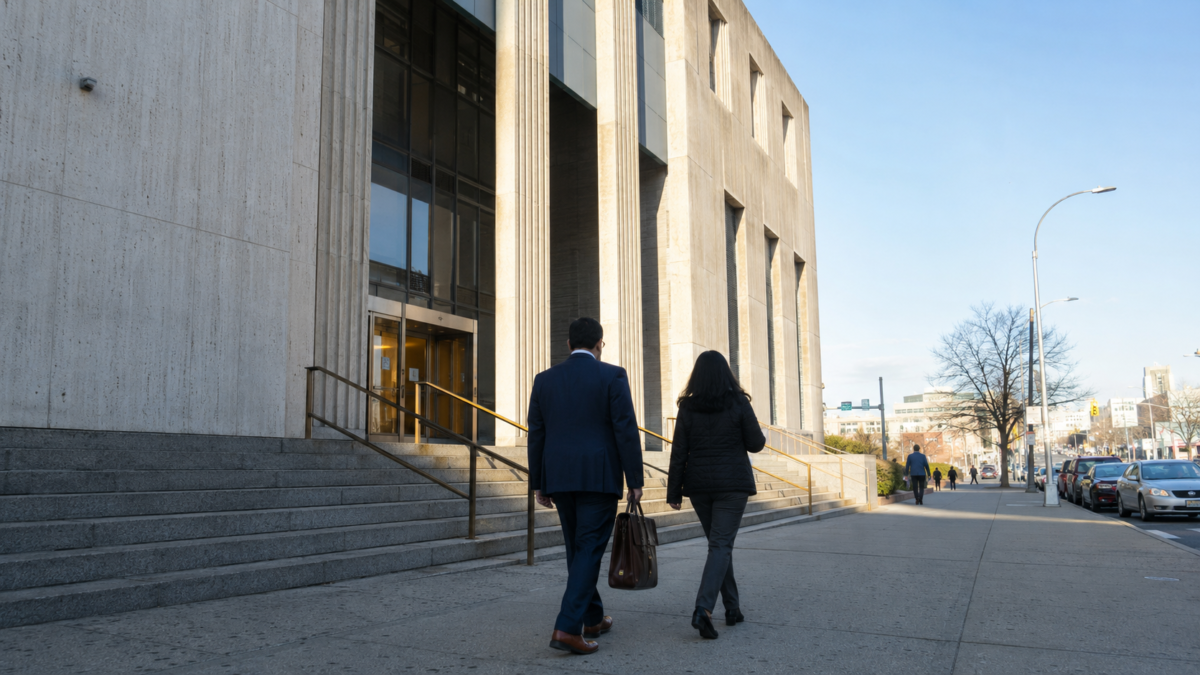
You got a court notice in the mail. Maybe it’s a petition from your landlord, or maybe you’re a property owner who just filed a non-payment proceeding and you have no idea what comes next. Either way, you’re going to Queens Housing Court, and you want to know what you’re walking into before you get there.
This guide covers exactly that: where the courthouse is, how to navigate it when you arrive, how cases get called, what happens at a first appearance, and the legal thresholds that matter before any case even reaches a judge. Whether you’re a tenant facing eviction or a landlord trying to recover possession of your property, the procedural mechanics are the same. Understanding them can make the difference between a resolved case and a costly mistake.
Queens Housing Court: Location and What to Bring
Queens Housing Court is located at 89-17 Sutphin Boulevard, Jamaica, NY 11435. The courthouse is part of the Queens Civil Court complex and handles all landlord-tenant proceedings filed within the borough.
By subway, take the E, J, or Z train to Jamaica Center (Parsons/Archer). The courthouse is a short walk from the station. If you’re driving, be aware that parking near the building can be tight during peak morning hours; plan to arrive early. The court opens at 9:00 a.m.
Bring everything related to your case: the court notice, your lease, any rent receipts or payment records, correspondence with your landlord or tenant, and any photos or documentation of conditions you plan to reference. You’ll go through a security checkpoint at the entrance. Leave extra time for that.
Bring patience. Bring something to read.
How the Clerk’s Office Works
Once inside, the clerk’s office is your first stop if you have procedural questions: confirming your part assignment, filing a response (called an answer), or requesting an adjournment. Clerks can tell you which courtroom your case is assigned to and hand you standard court forms. What they can’t do is give you legal advice. That distinction matters, and the clerks will tell you so.
If you’re a landlord filing a new case, you’ll begin here. Non-payment proceedings and holdover proceedings both originate at the clerk’s window. The filing fee for a non-payment petition is modest, but the paperwork requirements are specific. An error in the petition (a wrong address, an incorrect rent amount, improper service) can get a case dismissed before it ever reaches a judge.
Tenants who receive a petition and want to file a written answer should do so before their court date. An answer isn’t required in Housing Court, but filing one preserves defenses and signals to the court that you intend to contest the proceeding.
The Part System: How Cases Get Called
Queens Housing Court operates on a part system. Cases are assigned to specific parts (courtrooms) based on the type of proceeding. Non-payment cases, holdover proceedings, and HP actions (brought by tenants to compel repairs) each have their own designated parts.
When your case is called depends on the calendar that day. In the morning session, the court calls cases roughly in the order they appear on the list. This is a busy courthouse; on a given morning, dozens of cases may be scheduled in the same part. Early arrivals get their cases heard earlier, but there’s no guarantee of timing. Cases involving represented parties often move faster than those where someone is appearing pro se, because attorneys can handle paperwork and negotiation efficiently.
When your case is called, both sides approach. If one party doesn’t appear, the case can proceed by default, against the no-show. For landlords, a default judgment can mean a judgment for possession and a money judgment for unpaid rent. For tenants, it can mean a warrant of eviction issued without anyone having heard their side.
The First Appearance: What Actually Happens
Most cases don’t get resolved the first day. The first appearance in a non-payment or holdover proceeding is typically a conference, not a trial. The judge or a court attorney will hear briefly from both sides, assess whether there’s a potential resolution, and either facilitate a settlement or schedule the case for a future date.
In non-payment cases, the most common resolution at first appearance is a stipulation of settlement. The parties agree in writing to a payment plan: the tenant agrees to pay the arrears by a specific date, and the landlord agrees to accept that payment in satisfaction of the judgment. These stipulations are enforceable court orders. If the tenant defaults on the payment plan, the landlord can request a warrant of eviction without going back to trial.
Holdover proceedings are more varied. They include cases where a lease has expired and a tenant remains, cases involving chronic non-payment labeled as holdovers, cases alleging lease violations, and cases involving owner-use or demolition. The facts drive the process differently in each type. A holdover alleging lease violations may require a full evidentiary hearing. An expired lease holdover in a rent-stabilized unit raises different questions about the landlord’s renewal obligations under the Rent Stabilization Code.
Whatever the case type, the first appearance sets the tone. Parties who come prepared (with documentation, a clear understanding of their position, and realistic expectations) move their cases forward. Those who show up uncertain of what they want often leave with an adjournment and no progress.
Notice Requirements: Before the Case Gets Filed
One of the most common procedural errors, from both landlords and tenants, involves notice. Before a landlord can file in Housing Court, specific notices must be properly served. Defective notice is a defense that can end a case at the threshold, and it’s one of the first things an attorney reviews.
In a non-payment proceeding, the landlord must first serve a written rent demand, typically a 14-day rent demand (sometimes called a “predicate notice”), before filing. This demand must specify the amount owed and comply with the requirements of the Real Property Actions and Proceedings Law.
In holdover proceedings, the required notice depends on the circumstances. For month-to-month tenancies or expired leases in non-rent-stabilized apartments, the landlord must serve a notice of termination giving the tenant a reasonable time to vacate. Under Real Property Law Section 226-c, as amended by the Housing Stability and Tenant Protection Act of 2019, the required notice period scales with the length of tenancy: tenants who have lived in their apartments for less than one year must receive 30 days notice; one to two years requires 60 days notice; two or more years requires 90 days notice. These are minimum thresholds; a lease may require more.
For rent-stabilized tenants, additional protections apply under the Rent Stabilization Code (9 NYCRR Part 2524). A landlord cannot simply decline to renew a stabilized lease without a legally recognized ground, such as an owner-use claim, chronic non-payment, or substantial lease violations. Courts scrutinize these grounds carefully.
After a Judgment: The Warrant Process
When a landlord obtains a judgment of possession, the court may also issue a warrant of eviction. The warrant authorizes a New York City Marshal to carry out the eviction. But the issuance of a warrant doesn’t mean the tenant is removed the same day.
In non-payment cases, a tenant who pays all rent arrears and legal fees before the warrant is executed can stop the eviction under RPAPL Section 749. The right to redeem exists until the marshal actually carries out the removal.
When a warrant is ready to be executed, the assigned NYC Marshal is required to post a 72-hour notice of eviction on the tenant’s door before physically carrying out the removal. That notice gives the tenant a final window to vacate voluntarily or seek a stay from the court. A stay of eviction can be obtained by filing an order to show cause, a motion asking the court to halt execution of the warrant temporarily while a judge reviews new circumstances, such as payment of arrears, an application for emergency rental assistance, or a claim of improper procedure.
Tenants who receive a marshal’s notice should contact an attorney immediately. The 72-hour window closes fast.
Should You Have an Attorney?
New York City has right-to-counsel protections for tenants in Housing Court who meet income eligibility requirements, including in Queens. If you qualify, you may be able to obtain free legal representation through organizations like Legal Aid or Legal Services NYC. The court can provide information on eligibility and referral.
That said, right-to-counsel programs have capacity limits, and not every tenant will qualify or be matched with counsel before their court date. And for landlords, no such program exists, so you’re navigating this on your own unless you hire an attorney.
The procedural traps in landlord-tenant cases are real: predicate notice defects, improper service, failure to meet rent stabilization requirements, stipulations signed without understanding their terms. These are the situations where having a Queens landlord-tenant attorney changes the outcome of a case. Not because of courtroom drama, but because someone who knows the rules catches the error before it becomes a judgment.
At The Law Office of Edwin Maria, P.C., we represent both tenants and landlords in Queens Housing Court. If you’re facing a non-payment proceeding, a holdover, a warrant of eviction, or an HP action, our office can help you understand where your case stands and what your options are. Contact us to schedule a consultation.
Frequently Asked Questions About Queens Housing Court
Where is Queens Housing Court located?
Queens Housing Court is at 89-17 Sutphin Boulevard, Jamaica, NY 11435. It’s accessible by the E, J, and Z subway lines at Jamaica Center (Parsons/Archer). Court opens at 9:00 a.m. Plan to arrive early to get through security and locate your assigned courtroom.
How long does a landlord-tenant case in Queens take?
It varies significantly by case type and the positions of the parties. A non-payment case where the tenant can pay in full may resolve at the first appearance through a stipulation. A contested holdover proceeding involving substantial lease violations or rent stabilization questions can take months to reach a hearing. Adjournments are common, particularly when parties are unrepresented or when discovery is needed.
Can a landlord evict a tenant in Queens without going to court?
No. Self-help eviction (changing the locks, removing a tenant’s belongings, or shutting off utilities to force a tenant out) is illegal in New York State. A landlord must obtain a judgment of possession from the court and then have a licensed NYC Marshal execute a warrant of eviction. Any other method exposes the landlord to civil liability and potential criminal penalties.
What is a stipulation of settlement?
A stipulation is a written agreement between the landlord and tenant, entered on the record in court, that resolves the case on agreed terms. In non-payment cases, stipulations typically set a payment schedule for rent arrears and contain a conditional judgment: if the tenant pays as agreed, the proceeding ends; if not, the landlord can request a warrant. Tenants should read every stipulation carefully before signing. The terms are enforceable and waiving rights in a stipulation is binding.
Do I need a lawyer to appear in Queens Housing Court?
You’re not required to have one, but the procedural complexity and the consequences of getting things wrong make representation worth serious consideration. For tenants, right-to-counsel programs may cover representation at no cost if you qualify. For landlords, an unrepresented appearance risks defective filings, missed defenses raised by the tenant, and disadvantageous stipulations. Our office handles cases for both sides. You can learn more about our Queens practice here.
What is an HP action?
An HP action (Housing Part action) is a proceeding brought by a tenant to compel a landlord to make repairs and correct housing code violations. These are filed in Housing Court, not by the landlord, but by the tenant. If the court finds violations exist, it can order the landlord to correct them within a specific timeframe and, in some cases, impose civil penalties. HP actions are a tool tenants in Queens can use when a landlord fails to maintain habitable conditions.
By Edwin Maria, Esq. | The Law Office of Edwin Maria, P.C. serves tenants and landlords in Queens, the Bronx, Manhattan, and Brooklyn. For questions about a pending Housing Court matter, contact our office to discuss your situation.
Disclaimer: The information provided in this blog post is for general informational purposes only and should not be construed as legal advice. Every case is unique. Past results do not guarantee future outcomes.