
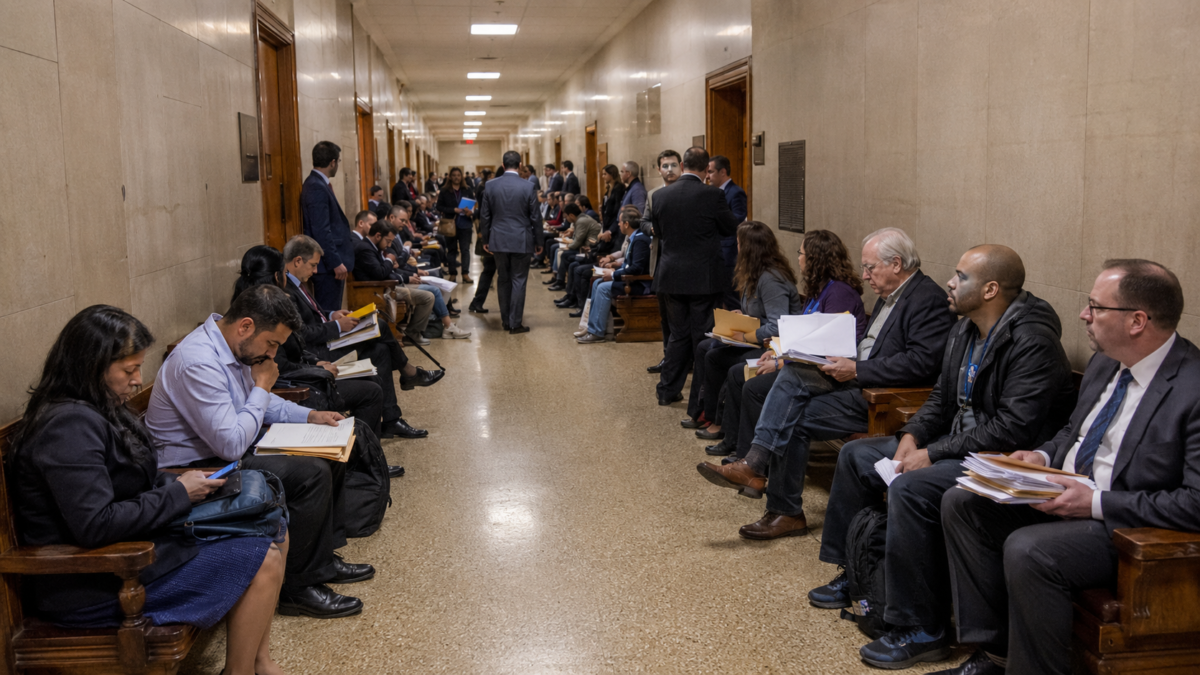
In 2025, a new Practice and Policy Advisory Committee was formed to address the crisis in New York City Housing Court. Cases are taking an average of fifteen months to resolve. Eviction filings are climbing. And despite the Right to Counsel law passed in 2017, tenant representation rates have not kept pace with need. I’m glad someone in an official capacity is paying attention. I’m also skeptical, and I want to be honest about why.
Fifteen Months Is Not a Statistic to Me
When I read that the average case in NYC Housing Court takes fifteen months to reach disposition, I don’t process that as an abstract policy number. I process it as what I’ve lived repeatedly with my clients.
Fifteen months means a landlord, often a small property owner and not a real estate corporation, going over a year without rent from a nonpaying tenant, unable to recover the unit, watching legal fees accumulate. It means a tenant living under the cloud of an open eviction case, unable to apply for housing elsewhere because the proceeding shows up on background checks. It means both sides paying attorneys, taking off work to appear in court, and repeatedly being told to come back in three months.
I represent landlords. I represent tenants. In a functioning Housing Court, neither side should be waiting fifteen months for resolution of a straightforward nonpayment case. That’s not a system serving anyone well.
What Got Us Here
The backlog didn’t materialize overnight. The COVID eviction moratoriums created a massive pileup of deferred cases that the courts have never fully worked through. The Right to Counsel law, which I support in principle, increased the number of represented tenants. That’s good. But it also increased the complexity and length of proceedings, which added pressure to a system that was already struggling. Filing volumes have climbed back toward pre-pandemic levels and beyond.
The court’s physical infrastructure hasn’t changed. The number of judges hasn’t changed enough. The clerk’s office, which processes the paperwork that keeps cases moving, is chronically understaffed. Every practicing attorney in Housing Court knows this. It is not a secret.
The Committee Question
Here’s my honest reaction to the advisory committee: committees get formed. Reports get written. Recommendations get issued. Courts stay overwhelmed. I have watched this cycle in various forms throughout my career in this system, and I say that without any pleasure.
That’s not to say the committee is useless. Having a formal body document what’s actually happening, with current data, creates a public record that can support funding requests and legislative action. That matters. But a committee cannot hear cases. A committee cannot process filings. A committee cannot give a judge the bandwidth to think through a complicated Good Cause Eviction challenge or a complex holdover proceeding.
What Would Actually Help
I’ll say plainly what I think needs to happen, because practitioners who work in this building every week owe it to the public to be direct.
The court needs more judges. Not task forces about judges, but actual judges, funded and appointed. It needs more clerks and more investment in the administrative infrastructure that determines how fast cases move through the system. And it needs a serious, good-faith conversation about which cases actually require full adversarial litigation versus which disputes could be resolved faster through mediation, administrative adjudication, or streamlined resolution tracks.
Not every nonpayment case needs to take fifteen months. Many of them don’t need to go to trial at all. There are cases where the facts are essentially undisputed and the only question is time to pay or a move-out date. Those cases should not be sitting in the same queue as complex holdover proceedings with genuine contested issues of law.
The advisory committee, if it does its job well, should be making exactly this argument to the people who control court budgets. I hope it does. But I’ve been in this courthouse long enough to know that hope is not a case strategy.
This article reflects my personal opinion as a practicing NYC attorney and is not legal advice. Every situation is different. If you have a specific legal question, contact my office.